
Trafficity vs Mini Motorways: Which Traffic Game
Trafficity and Mini Motorways look similar and play nothing alike. Compare road control, failure modes, price and replay value before choosing.
Both games are about cars on roads you draw. Both are small, cheap and quietly addictive. That is where the similarity ends. Mini Motorways is a route-drawing score chase with random road pieces; Trafficity is a road engineering sandbox with a junction editor. Choosing between them is really choosing which kind of problem you want to solve.
The short version: Mini Motorways is a better game to replay for score, Trafficity is a better game to build in. If you want to draw a beautiful interchange and watch it work, Trafficity. If you want a tight fifteen-minute run that you can lose in a satisfying way, Mini Motorways.
The lane connections guide→ shows the control that Mini Motorways does not offer at all.
The core difference
Mini Motorways gives you a hand of road tiles. You place them, connect houses to destinations, and the road network is constrained by what you drew. You cannot widen a road, add a lane or change a junction type. The skill is in planning ahead with limited pieces.
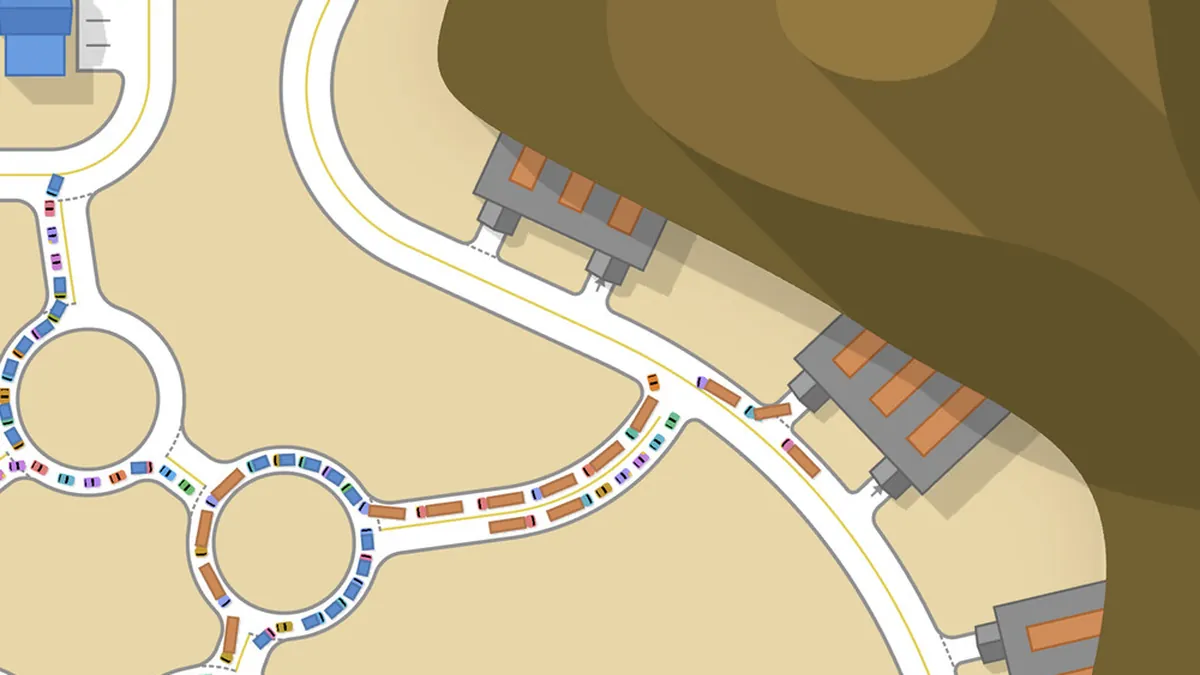
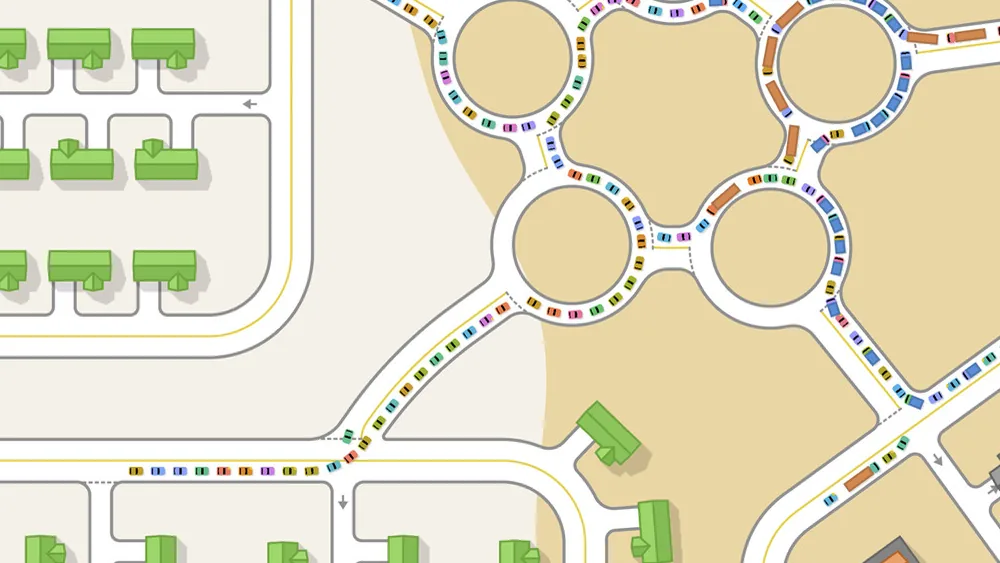
Trafficity gives you a freeform road tool, lane additions, roundabouts, overpasses, signals with phases and a lane-connection editor. There is no hand of tiles and no score. The skill is in diagnosing why a junction fails and rebuilding it.
| Aspect | Trafficity | Mini Motorways |
|---|---|---|
| Road tools | Freeform, any angle, lane-level edits | Tile-based, fixed pieces |
| Junction control | Roundabouts, signals, phases, connections | Implicit, no junction editing |
| Goal | Grow a city, keep it moving | Score as long as possible |
| Run length | Hours per city | Minutes per run |
| Failure | Gradual congestion, fixable | Sudden overload, run over |
| Price | $13.49 | Lower, frequently discounted |
Where Trafficity wins
Control. There is nothing in Mini Motorways like the junction panel in Trafficity - the ability to say which lane may turn where, and which movements share a green. That is the whole appeal: you are not managing a queue, you are designing the thing that creates it.
Persistence. A Trafficity city keeps growing. You can spend an evening on one save, come back to it, and continue. Mini Motorways runs are disposable by design.
Teaching. Because failures are structural, Trafficity teaches you something transferable: how a roundabout differs from a signal, why a slip lane helps, why a queue grows upstream of a blocked exit. That knowledge makes the game's later biomes genuinely easier.
Where Mini Motorways wins
Clarity. A Mini Motorways run has an obvious score and an obvious end. Trafficity's feedback is visual and indirect, and a new player can spend an hour unsure whether their city is doing well.
Replayability. Randomised tile draws give Mini Motorways enormous replay value for its size. Trafficity's procedural maps help, but a city is a commitment.
Pacing. Fifteen minutes versus an evening. If your play time comes in short blocks, Mini Motorways fits better.
Owning both is reasonable. Mini Motorways is a coffee-break game; Trafficity is a project. The overlap is the theme, not the loop.
Which is harder?
Trafficity is harder in the sense that it can fail slowly and confusingly. A junction that is 10 percent over capacity will not end your game; it will just make one district unhappy for an hour while you work out why.
Mini Motorways is harder in the sense that it is unforgiving in the moment. One missed connection during a surge ends a run that was going well.
Most players find Trafficity's difficulty more forgiving overall, because mistakes can be rebuilt. The review→ covers that in more detail, including where the thin economy makes diagnosis harder than it should be.
Price and platform
Trafficity is $13.49 on Steam, Windows only. Mini Motorways is cheaper, has been heavily discounted, and is available on more platforms including mobile and Apple Arcade. If you want to play on a phone or a tablet, that decision is already made for you - see the mobile page→ for why Trafficity is not an option there.
If you have not played either, Mini Motorways is the lower-risk entry point and often costs less than a coffee. If you bounce off it because you wanted more control, Trafficity is exactly the answer.
Verdict
Choose Trafficity if the fun for you is in the junction: the geometry, the phases, the lane connections, the moment a queue disappears because you moved one connection. Choose Mini Motorways if the fun is in the run: the score, the pressure, the restart.
Both are good at what they do. The mistake is buying one expecting the other.
Where the data comes from
- Trafficity on Steam ↗ - store description, price and feature list.
- Trafficity news hub ↗ - patch notes and developer posts.
- Steam global achievement percentages ↗ - the public endpoint behind the completion figures quoted here.
Official source: Trafficity on Steam ↗
FAQ
Is Trafficity a Mini Motorways clone? No. They share a theme, not a design. Trafficity has freeform roads and a full junction editor; Mini Motorways uses tiles and has no junction control.
Which is better for casual play? Mini Motorways. Its runs are short and self-contained. Trafficity asks for longer sessions and a willingness to diagnose.
Is Trafficity harder? It is more complex, but more forgiving, because a failing city can be rebuilt rather than restarted.
Can I play Trafficity on mobile like Mini Motorways? No. Trafficity is Windows only on Steam.