
Trafficity Roundabout Guide: Size, Entries and Lanes
Trafficity roundabout guide: entry counts, single versus double lane rings, connections inside the circle, and when a signal wins.
A roundabout is the safest default junction in Trafficity. It has no signal phases to balance, no lost time, and it fails visibly: when it is overloaded, cars queue on the approach where you can see them instead of deadlocking in the middle. That is why the first junction in most working cities is a roundabout, and why most of those cities keep it for thirty levels.
The catch is that a roundabout only works if its entries and internal lanes are connected properly. A circle with four permissive entries and no lane discipline weaves, and weaving looks exactly like a capacity problem while being nothing of the sort.
If the entries are already uneven, the lane connections page→ explains the panel that fixes it.
Size it by entry count
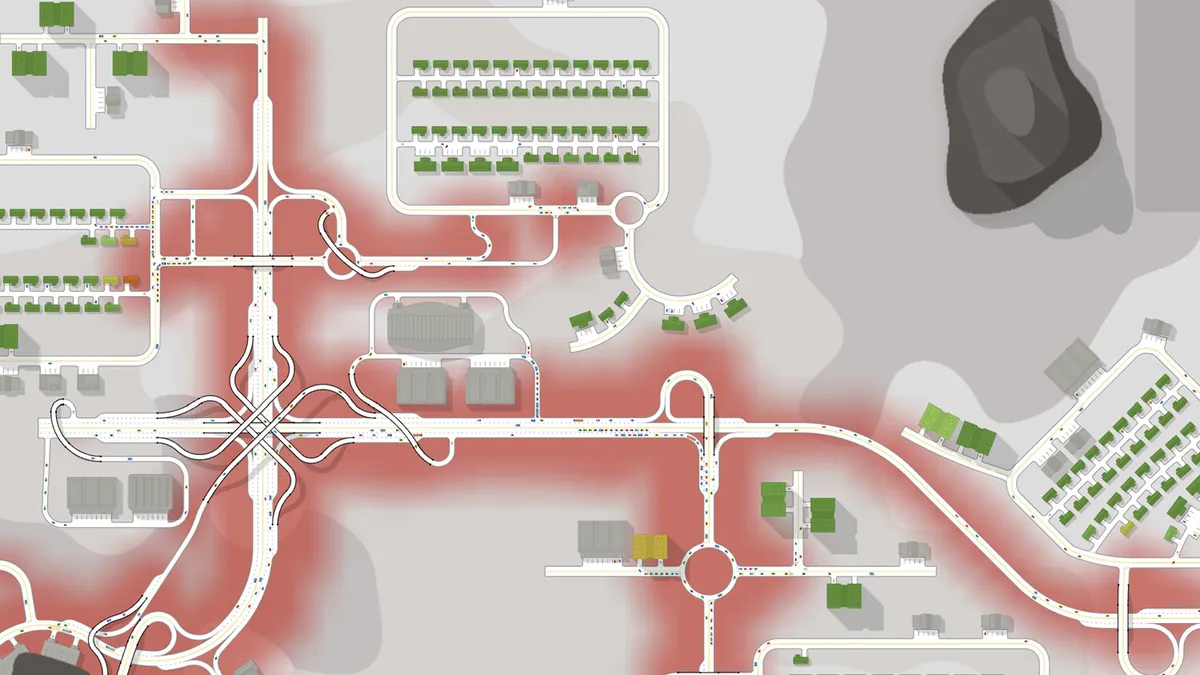
The main sizing decision is how many roads meet the circle. Three entries is comfortable, four is the practical maximum for a simple roundabout, and five or more is a sign that the road network is doing something wrong upstream.
| Entries | Typical use | Watch for |
|---|---|---|
| 3 | District entrance, T-junction replacement | Uneven loads if one entry carries the arterial |
| 4 | Two arterial roads crossing | One entry saturating the ring |
| 5+ | Should be redesigned | Internal weaving, ring lock |
Build the circle large enough that a queue inside the ring cannot reach back to the next entry. If the ring is so small that two cars queuing to exit block the entry behind them, the roundabout locks - and a locked circle takes far longer to clear than a signal queue.
A roundabout with buildings tight to its edge cannot gain a slip lane or a second entry later. Treat the ring plus one building's width as reserved space.
Single lane or double lane
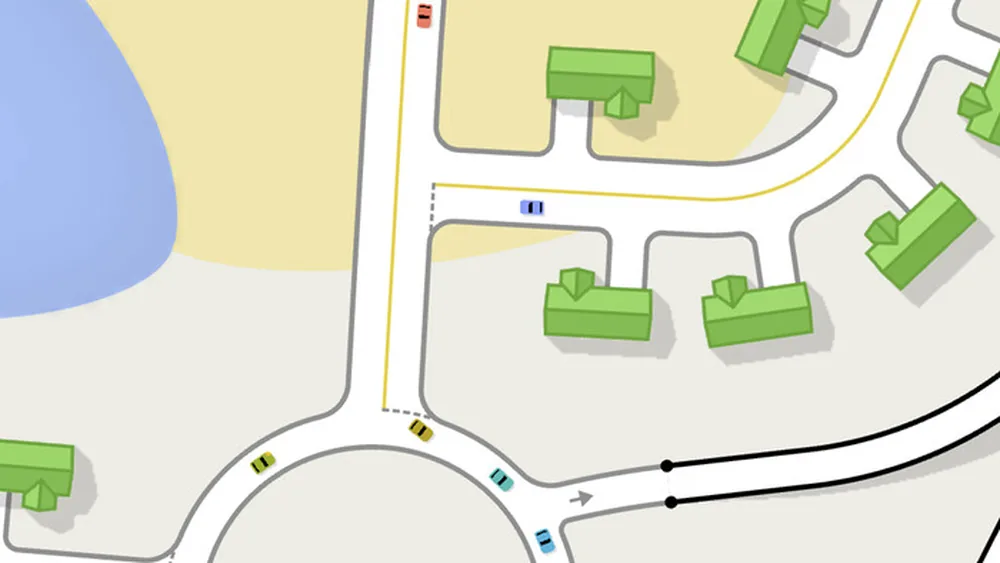
A single-lane roundabout is the right starting point for almost every junction. It has one circulating lane, one entry lane per approach, and no internal lane changes. Cars enter when there is a gap and leave at their exit. It is boring and it works.
A double-lane roundabout roughly doubles capacity, but only if the lane connections are disciplined:
- The outer entry lane connects to the outer circulating lane and the first exit.
- The inner entry lane connects to the inner circulating lane and the later exits.
- No entry lane connects to every exit.
If you connect every entry to every exit, cars will cut across the circle at the last moment, and the internal weaving will destroy the capacity you built the second lane for. The connection rules are the same ones described in the lane connections guide→.
Roundabouts with slip lanes
The cheapest capacity upgrade for a roundabout is not a second ring lane - it is a slip lane. A right-turning movement that leaves before the circle and rejoins after it never enters the roundabout at all. That removes an entire approach movement from the ring's workload.
Slip lanes work best where the right turn is common and the geometry allows a separate lane to peel off early. On a four-entry roundabout, adding slip lanes on two of the entries can be equivalent to widening the ring, at a fraction of the cost and with no internal weaving.
Build the slip lane as a lane addition on the approach, connect it only to the right-turn exit, and leave the main approach lane connected to the circle. The road tool guide→ covers the lane addition itself.
When a roundabout is the wrong choice
A roundabout is the wrong tool when one movement dominates. If eighty percent of the traffic wants to go straight through from north to south, the circle forces all of it to slow down and circulate. A signal with a long green for that movement will outperform it.
It is also the wrong tool when pedestrian or property space is tight and the circle would be very small. A small roundabout locks easily; a compact signal junction degrades more gracefully.
And it is the wrong tool where two arterials cross at high volume in both directions. That is an interchange problem - grade separation - not a roundabout problem. The interchange guide→ covers that case.
If cars cannot leave the junction because the road beyond is full, the circle fills and locks. Look downstream before you resize the ring.
Converting an existing junction
Replacing a signalised crossing with a roundabout is usually straightforward: demolish the junction, draw the circle, reconnect the four approaches. Keep three things in mind.
- Preserve the turn pockets on the approaches. A roundabout entry still benefits from a dedicated right-turn lane if a slip lane is possible.
- Recheck the connections after the rebuild. A new circle resets them, and the default set may be more permissive than you want.
- Watch the first rush hour. Roundabouts that look fine at low flow can lock when a single entry saturates.
If the rebuilt roundabout jams in the same place as the old junction, the problem was never the junction type. Go back to bottleneck diagnosis→ and check the downstream road.
Where the data comes from
- Trafficity on Steam ↗ - store description, price and feature list.
- Trafficity news hub ↗ - patch notes and developer posts.
- Steam global achievement percentages ↗ - the public endpoint behind the completion figures quoted here.
Official source: Trafficity on Steam ↗
FAQ
How many lanes should a Trafficity roundabout have? Start with one circulating lane. Add a second only when the overlay shows persistent queuing on more than one entry.
How many entries can a roundabout handle? Three or four. Five or more usually means the surrounding network needs a bypass instead.
Why does my roundabout lock up? Either an exit is blocked so cars cannot leave the circle, or the ring is too small for the queue at an exit. Both are downstream problems.
Do roundabouts need traffic lights? Not normally. A signalised roundabout is a real-world option, but in Trafficity a signal at one entry is usually enough if a single approach dominates.