
Trafficity City Expansion: Grow Without Gridlock
How to expand a working Trafficity city: build the ring before the second district, add industrial spurs, and keep cross-town traffic out of the old centre.
Every working Trafficity city reaches the same moment: the original district is full, the roundabout is at its limit, and there is open land on the other side of the map. The obvious move - build a second district and connect it to the same central junction - is the move that kills the save.
Expansion is not about adding roads. It is about adding traffic to a network that was designed for less of it, which means the network has to change shape first. This page is the order of operations.
The early game layout→ decides how much room the later city has to work with.
Rule one: build the ring before the district
The sequence matters more than the design. A second district connected to the existing centre adds cross-town trips to the busiest junction in the city. A ring built first carries those trips around the centre, and the second district then connects to the ring rather than the core.
The practical order:
- Clear the ring corridor. You reserved it during the early game, so this is mostly about removing anything that grew into it.
- Draw the ring at arterial width, with junctions only where districts will connect.
- Connect the ring to the existing arterial network at two or three points, not everywhere.
- Only then build the second district, and connect it to the ring, never to the old centre.
If the ring cannot be completed - water, terrain, or a district in the way - do not start the second district until you have an alternative route. A half-ring sends traffic back through the centre at the gap, which is worse than no ring at all.
Rule two: separate new industry from old housing
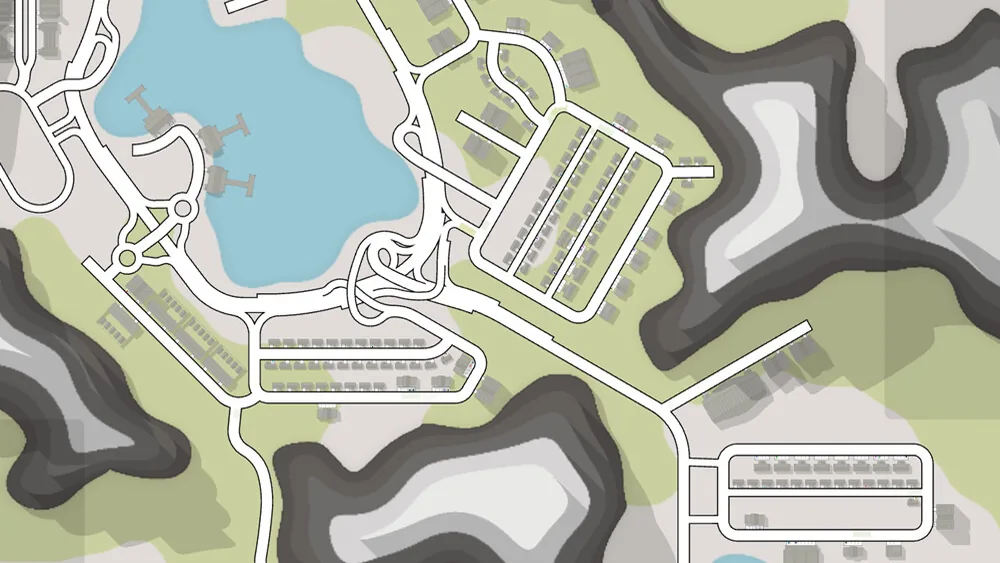
Industrial expansion is the easiest way to ruin a residential area. New factories bring heavy vehicles, shift-change surges and pollution, and the shortest route to the map edge often runs through the oldest, densest housing.
Put new industry on a spur that connects to the ring, not to the residential grid. The spur should have two connections to the ring if the zone will grow, so a single blocked junction does not isolate it.
The road hierarchy guide→ explains the access rule in detail: no building on an arterial, no local street directly on the arterial network. Industry is where that rule pays off most.
Rule three: promote the roads that changed job
As districts merge, a collector that served one neighbourhood becomes the road between two. That is a promotion, and it needs to be treated as one: wider, with fewer direct building accesses and proper junctions at each end.
The alternative - leaving it as it was and adding a parallel road - produces two similar routes that split traffic unpredictably. The simulation will use whichever is faster today, and which one that is will change as the city grows.
Pick the single road that carries the most cross-district traffic after each expansion and upgrade it. One promotion per phase is enough, and it keeps the hierarchy legible.
Rule four: add capacity at the destination, not the route
A new district needs a destination. If the new housing has no shops and no workplaces of its own, every resident will drive to the old centre, and the ring will deliver them there faster than before. The result is a bigger queue at the same junction.
Before the new district fills, place its shops and its workplaces. A district that can satisfy most of its own trips is a district that does not overload the ring.
Rule five: do not rebuild the centre
The instinct when the old centre jams is to rebuild it. Resist that until the ring and the district connections are working. Most centre jams after an expansion are caused by through-traffic that should be on the ring, not by the centre's own junctions.
Check that first: if the central junction's queue is mostly cars passing through, the ring is incomplete or unattractive. Fix the ring, and the centre recovers without a rebuild.
A grade-separated crossing moves traffic to the next junction faster. If the ring is feeding a junction that cannot absorb it, an interchange on the ring will simply deliver a larger queue sooner. See the interchange guide→ for when one is justified.
A phased expansion plan
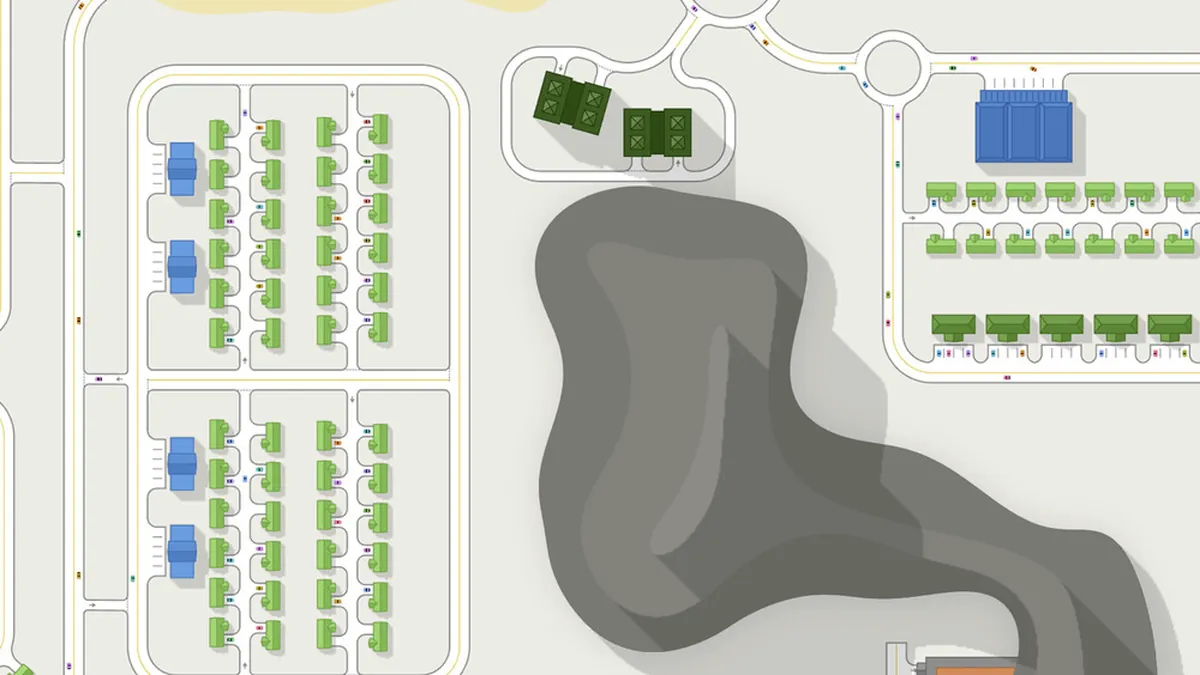
The sequence that works at most city levels:
| Phase | Build | Check before moving on |
|---|---|---|
| 1 | Ring corridor cleared and drawn | Ring carries through-traffic without touching the centre |
| 2 | Two or three ring connections to existing arterials | Each connection clears within a peak cycle |
| 3 | Second residential district on the ring | District has its own shops before it fills |
| 4 | Industrial spur with two ring connections | Shift-change queue clears the spur |
| 5 | Promote one cross-district road | Promoted road stays clear at peak |
That is slower than placing buildings, and it is why cities that follow it keep working at level 40.
When growth is not the answer
Not every city needs to expand. If the goal is a specific achievement - reaching level 25 or 40 - expansion is required, because city level comes from buildings. If the goal is a city you enjoy watching, a compact city with a well-tuned ring can be more satisfying than a sprawl.
Either way, the decision should be deliberate. Expanding because there is empty land is how players end up with a city that is large and permanently congested.
Where the data comes from
- Trafficity on Steam ↗ - store description, price and feature list.
- Trafficity news hub ↗ - patch notes and developer posts.
- Steam global achievement percentages ↗ - the public endpoint behind the completion figures quoted here.
Official source: Trafficity on Steam ↗
FAQ
When should I expand in Trafficity? When the current district is full and its junctions clear within a peak cycle. Expanding while the centre is failing adds traffic to a network that cannot absorb it.
Should I build the ring before or after the new district? Before. The ring carries cross-town traffic around the core; without it, the new district's trips land on the busiest junction.
How many connections should the ring have? Two or three to the existing arterials, plus one per district. More than that turns the ring into another local road.
Can I expand without a ring? Only if there is another through-route. A second district connected to a single central junction will jam quickly.