
Trafficity Road Hierarchy: Arterials, Collectors, Local
Trafficity road hierarchy: split roads into arterials, collectors and local streets, and keep through-traffic out of neighbourhoods.
Trafficity does not label roads. There is no road type dropdown, no zoning rule that forbids a highway through a suburb. The game gives you a road tool and a traffic simulation, and the hierarchy is something you impose. Cities that work have one; cities that jam usually do not.
The hierarchy is simple: arterials carry traffic between districts, collectors distribute it within a district, local streets serve the buildings on them. Three levels, three jobs. The failure mode is when a road does two jobs at once - a local street that also happens to be the fastest route across the map becomes a residential rat run, and no amount of housing policy fixes it.
If you are still choosing junction types, intersection basics→ is the shorter read.
What belongs on each level
| Level | Job | Connects to | Never |
|---|---|---|---|
| Arterial | Move cars between districts | Collectors, other arterials, ramps | Buildings directly |
| Collector | Spread traffic inside a district | Local streets, arterials | Other districts |
| Local | Serve the buildings on it | Collectors only | The arterial network |
Two rules follow from that table, and they do most of the work:
- No building touches an arterial. Shops and houses on an arterial generate turning traffic, and a single car waiting to turn into a driveway can stop a lane. Keep a service road or a parallel local street and let the arterial be a clean through route.
- Local streets never connect directly to the arterial network. Every local trip goes through a collector first. That one rule is what prevents a shortcut from becoming a bypass.
A collector should touch an arterial in one or two places. If it touches in five, it is an arterial that happens to be narrow. That is the single most common hierarchy mistake in Trafficity, and it shows up as red on the collector, not on the main road.
The penetration problem
The most damaging traffic pattern in the game is through-traffic in a residential area. It happens when the arterial network is incomplete: a driver's fastest route crosses a district because the ring road has a gap. The simulation does exactly what it promises - cars take the fastest route - so the district gets the traffic.
The fix is never a sign or a speed bump, because the game has neither. The fix is geometry:
- Close the gap in the arterial network, even if the detour looks longer on the map.
- Make the through-route faster than the shortcut by keeping it wider and junction-free.
- If a district must be crossed, put the crossing on its edge, not through its centre.
Width follows level, not hope
A common reflex is to widen the arterial first. That usually moves the problem to the next junction. Width should follow level, and level should follow the job:
- Arterial: the widest road you can afford, with lane additions only at junctions where a turn needs its own pocket.
- Collector: two lanes is normally enough; add a turn pocket where it meets the arterial.
- Local: one lane each way, kept narrow on purpose so it is never the fastest route.
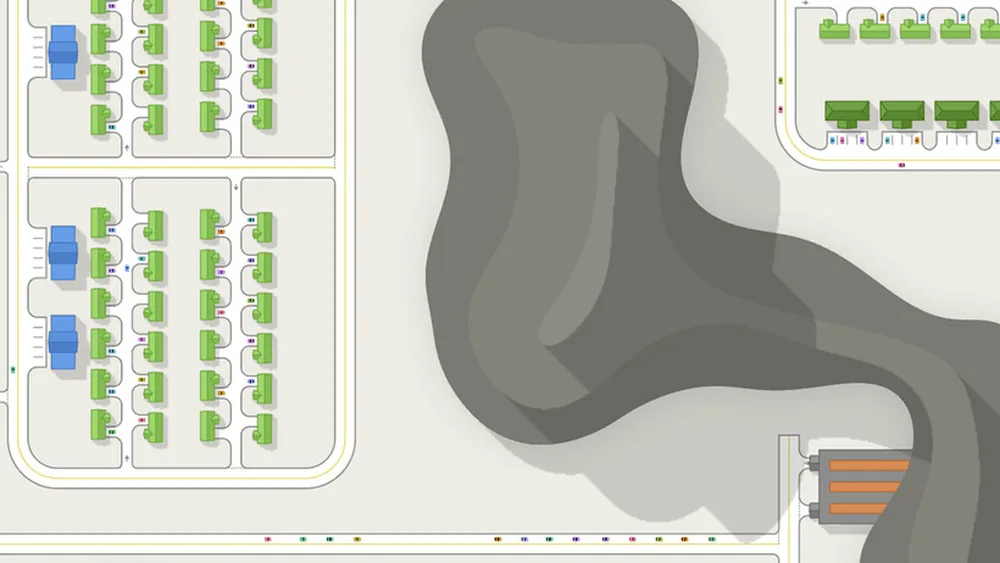
The simulation rewards speed and penalises stopping. A wide local street with clear sightlines becomes attractive as a shortcut, so keeping local streets narrow is a traffic-management decision, not an aesthetic one. The shape that makes this easiest to control is discussed in grid versus organic layouts→.
Adding lanes to an arterial approach does not increase what the junction can process. It shortens the queue and widens it. Fix the junction, then decide whether the road still needs the extra lane.
Hierarchy and city growth
As a city grows, districts that were separate become adjacent, and the roads between them change job. A collector that used to serve one neighbourhood now carries cross-town traffic. That is the moment to promote it: widen it, remove its direct building access, and give it a proper junction at each end.
The alternative - building a new arterial and leaving the old collector as it was - tends to produce two parallel roads splitting traffic unpredictably. The simulation will use whichever is faster today, which means the split changes as traffic changes. A clear hierarchy produces predictable routes, and predictable routes are diagnosable.
This is the same principle behind city expansion→: add a ring or a bypass before the centre saturates, and keep the new road at arterial level so through-traffic never has a reason to enter the old core.
A hierarchy you can check in-game
At any point in a save, you can audit the hierarchy in about a minute:
- Open the traffic overlay and find the longest red stretch.
- Ask what job that road is doing. If it is carrying cars from more than one district, it is acting as an arterial.
- Check whether it touches buildings directly, and whether local streets join it at close intervals.
- If either is true, the road is doing too many jobs. Fix by rerouting local access to a collector, not by adding lanes.
Do that after every few city levels and the network stays legible. Skip it and you end up with a city where every road is a little bit arterial and none of them works.
Where the data comes from
- Trafficity on Steam ↗ - store description, price and feature list.
- Trafficity news hub ↗ - patch notes and developer posts.
- Steam global achievement percentages ↗ - the public endpoint behind the completion figures quoted here.
Official source: Trafficity on Steam ↗
FAQ
Does Trafficity have road types? No. There is no formal hierarchy in the UI; you create it through width, connections and where you allow buildings.
How wide should an arterial be? Wide enough for its junction capacity, and no wider. Extra width on the approaches does not increase junction throughput.
Why do cars cut through my neighbourhood? Because it is the fastest route. Close the arterial gap or move the through-route to the district edge.
Can local streets connect straight to the arterial? They can, but each connection becomes a place where local traffic interrupts through traffic. Route local streets through collectors instead.