
Trafficity Interchange Guide: Overpasses That Work
When a Trafficity junction needs grade separation: overpass types, ramp geometry, where to put the first interchange and the layouts that avoid weaving.
An interchange is what you build when two roads both need to keep moving and neither can stop for the other. In Trafficity that means grade separation: an overpass carries one road above the other, and ramps handle the transfers. It is the most expensive thing you can build in the early game and the easiest to build badly.
The rule that saves the most money: do not build an interchange until you can name the two movements that justify it. If you cannot say "north-to-south through traffic and east-to-west through traffic both need uninterrupted flow", you probably need a roundabout and a bypass instead.
Start with road hierarchy→ if you are not yet sure which road deserves the grade separation.
Three shapes and when each fits
Diamond. The overpass carries the main road; four short ramps connect to a cross road at ground level. Compact, cheap, and the right first interchange for a city that needs one arterial to pass over a district road.
Trumpet. One road ends at the other in a T. Used where a new arterial meets an existing one and does not continue past it. It handles one heavy turning movement well.
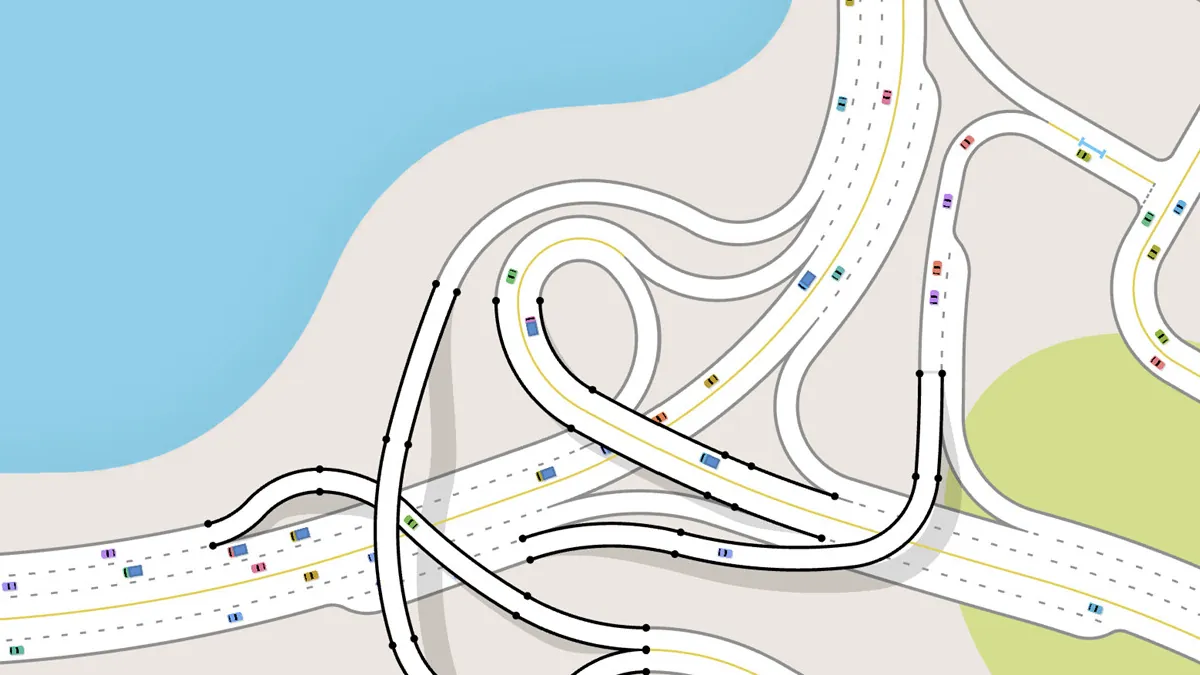
Stack or turbine-style. Multiple levels and curved ramps for two heavy arterials crossing. Expensive in space and money; the right answer only when both roads are genuinely arterial and the volume is persistent.
| Shape | Cost | Space | Best for |
|---|---|---|---|
| Diamond | Low | Small | Arterial over a district road |
| Trumpet | Medium | Medium | A road ending at an arterial |
| Stack / turbine | High | Large | Two heavy arterials crossing |
Draw the grade-separated road with no connections, confirm it carries traffic cleanly, then add ramps. Building both at once makes it hard to tell which part is causing a problem.
Ramp geometry is the whole game
An interchange with a bad ramp is worse than a junction, because the ramp hides the conflict until cars are already committed. Three geometry rules matter:
- Give the on-ramp length. A ramp that meets the main road at a sharp angle forces cars to slow down before merging, which puts a queue on the ramp. A long, shallow merge lets them arrive at speed.
- Never put an on-ramp and an off-ramp opposite each other. That creates a weaving segment where cars entering and leaving cross paths in a short distance. Offset them by at least a block.
- Keep the off-ramp clear of the next junction. If the ramp lands directly into a roundabout, the roundabout inherits all the motorway traffic. Give the ramp a short collector road to distribute into.
The highway ramps page→ goes deeper on merge and diverge geometry, including slip lanes.
Where the first interchange belongs
The best first interchange is usually not in the city centre. It is on the edge, where the arterial ring crosses the road to the industrial district or the second residential area. That location has two properties: the traffic is genuinely through traffic, and there is space to build ramps without demolishing anything.
Putting an interchange in the centre is tempting because that is where the red is. But a central interchange consumes an enormous amount of land, and the traffic it separates still has to enter the surface network somewhere. The result is usually a fast road that ends in a queue at the first surface junction.
Interchanges and the district grid
Grade separation changes what a district needs. Once an arterial passes overhead, the district below it becomes quieter, and the crossing points become the only places where local traffic can interact with the arterial. Those crossing points are now the district's gates, and they should be treated as junctions in their own right - usually a small roundabout on each side.
Two consequences:
- Do not connect every local street to the crossing. A district with six connections to a grade-separated arterial has effectively built six junctions on it.
- Keep the crossing points symmetric. If the north side has a roundabout and the south side has a bare T-junction, traffic will favour the easier one and overload it.
A grade-separated road moves cars to the next junction faster. If that junction is the real bottleneck, the interchange simply delivers a bigger queue, sooner.
When an interchange is the wrong answer
Three cases where you should not build one:
- The jam is caused by too many destinations in one district. Grade separation moves the queue, it does not reduce trips.
- The road is a local street that happens to be busy. Promoting it to arterial level is usually cheaper than separating it.
- You have not built the ring road. An interchange on an incomplete network concentrates traffic at the missing link, not at the crossing.
In all three cases the correct move is to fix the network shape first. The city expansion guide→ covers the ring-before-interchange sequence, and road hierarchy→ explains why a local street should never become the fast route.
A minimal interchange checklist
Before you commit the land, check:
- Both roads are arterial and stay arterial for several blocks on each side.
- The ramps have room to be long and shallow.
- On and off ramps are offset, not opposite.
- The off-ramp lands somewhere that can absorb traffic without a queue.
- There is a second route across the map, so the interchange is not the only crossing.
If any of those is false, a roundabout plus a bypass will usually serve you better and cost less.
Where the data comes from
- Trafficity on Steam ↗ - store description, price and feature list.
- Trafficity news hub ↗ - patch notes and developer posts.
- Steam global achievement percentages ↗ - the public endpoint behind the completion figures quoted here.
Official source: Trafficity on Steam ↗
FAQ
When should I build an interchange in Trafficity? When two arterial roads both need uninterrupted through movement and a roundabout or signal cannot provide it without unacceptable queues.
What is the best interchange type? A diamond is the best first choice. Stack and turbine layouts are for two genuinely heavy arterials and consume a lot of space.
Do overpasses reduce traffic? They reduce conflicts at one crossing. They do not reduce the number of trips, so the next junction still has to handle them.
Can I connect local streets to an overpass? Technically yes, but every connection becomes a junction on an arterial. Keep local access on the surface grid.