
Trafficity Highway Ramps: Merge Lanes That Actually Merge
Fix merging in Trafficity: ramp length, slip lanes, weave avoidance and the lane connections that stop an on-ramp queue from backing onto the highway.
Ramps are where a fast road meets a slow one, and in Trafficity that meeting is where most highway jams start. The pattern is recognisable: the main road is clear, the ramp is solid red, and the queue has backed up far enough to block the surface street that feeds it. Nothing is wrong with the highway. The ramp geometry is wrong.
The fix is usually one of three things - more ramp length, a slip lane, or better lane connections at the merge point. This page covers all three, plus the weaving problem that appears when you build an on-ramp and an off-ramp opposite each other.
Read the interchange guide→ first if the ramp is meant to meet a grade-separated junction.
Why ramps queue
A car entering a fast road has to match speed and find a gap. If the ramp is short, the car arrives at the merge point still slow, and the gap it needs is larger. If the ramp is steeply angled, the car has to slow down further before it can turn onto the main road at all.
In the simulation, cars are trying to keep moving at the speed the road allows. A short ramp forces a slow entry, a slow entry forces a bigger gap, and a bigger gap means fewer cars merge per second. The queue builds from the merge point backwards, and once it reaches the surface street it starts blocking junctions that have nothing to do with the highway.
Doubling the length of an on-ramp usually buys more merge capacity than adding a second ramp lane. Cars need distance to accelerate, and distance is the one thing a short ramp cannot fake.
Three ramp shapes
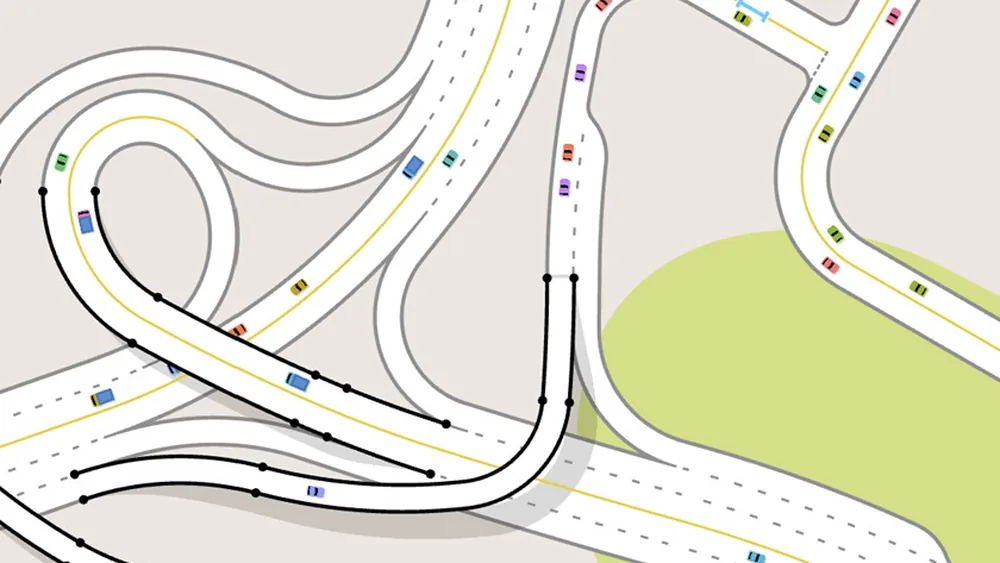
The long taper. The ramp runs almost parallel to the main road for several car lengths before joining. This is the best default: cars arrive at speed, the merge angle is shallow, and the entering lane can be connected to a single destination lane so nobody scatters.
The slip lane. A lane peels off before a junction and rejoins after it, letting right-turning traffic bypass the junction entirely. It works best where the turn is common and there is room to separate the lane early.
The loop. A curved ramp that turns through a wide angle to gain height or cross a road. Useful for interchanges where space is tight, but the curve costs speed, so the loop must end with a straight section long enough to accelerate before the merge.
| Ramp shape | Merge quality | Space needed |
|---|---|---|
| Long taper | Best | Medium |
| Slip lane | Good, removes junction load | Low |
| Loop | Depends on exit straight | High |
Connect the merge, do not just paint it
A ramp that physically joins the main road still needs lane connections at the junction point. The classic mistake is leaving the entering lane connected to every lane of the main road. Cars then spread across three lanes as they join, which forces the through traffic to brake and creates the weaving that looks like a jam.
Connect the ramp lane to one destination lane - usually the nearest - and let cars indicate and move over later. In the junction panel, that is a single drag. The practice is described in more detail in the lane connections guide→.
The weaving problem
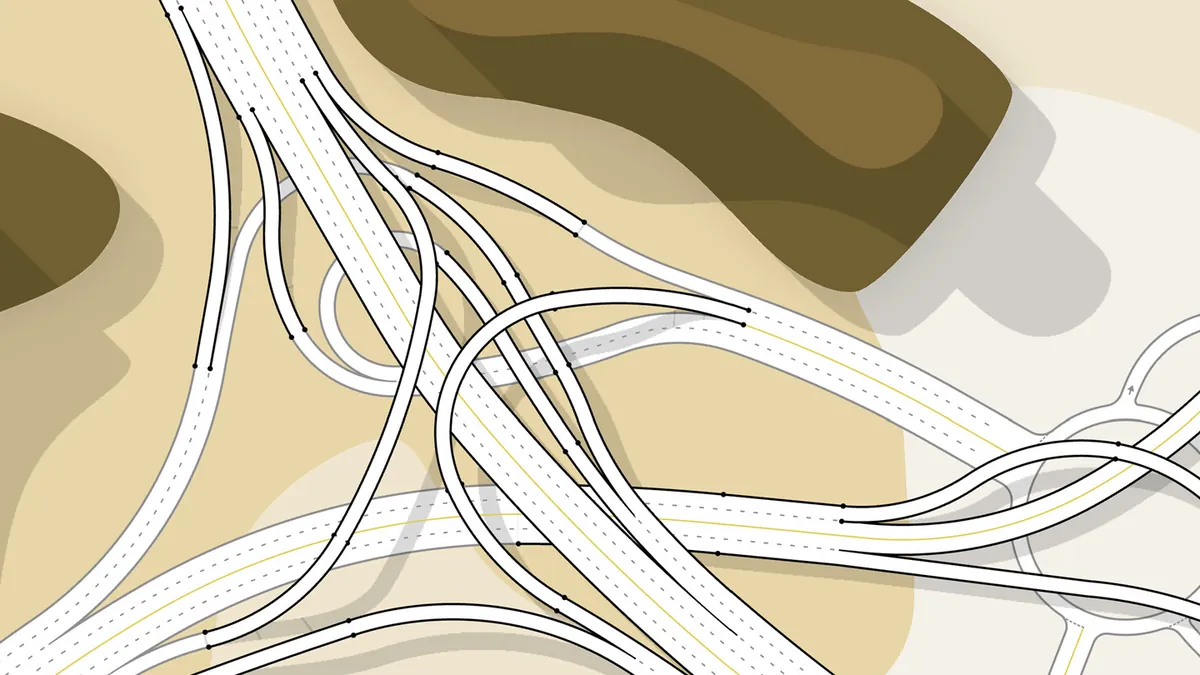
Weaving happens when an on-ramp and an off-ramp sit close together on the same side of a road. A car entering has to cross the path of a car leaving, and both are changing lanes in the same short stretch. In real traffic engineering this is measured as a weave length; in Trafficity you can see it as a short red segment that pulses with every cycle.
Two fixes, in order of preference:
- Offset the ramps. Move the on-ramp at least a block away from the off-ramp so cars finish merging before anyone needs to leave.
- Separate the movements with a collector. Let the off-ramp land on a parallel road that runs alongside the main road, so leaving traffic never crosses entering traffic.
The second option costs more space but scales better. It is the same principle as keeping local access off an arterial, covered in road hierarchy→.
An off-ramp that lands directly in a roundabout hands the entire highway volume to a junction designed for local traffic. Give the ramp a short collector road first.
Ramps and city growth
A ramp that works at level 10 will not necessarily work at level 30. The failure is gradual: the merge queue gets a little longer each time a new district opens, until one day it reaches the surface street. Because the change is slow, players often blame the surface junction that finally blocks.
The habit that prevents this is checking the ramp itself during a rush hour, not at noon. If the ramp queue extends past the halfway point of the ramp, it is already over capacity, even if it still clears between cycles. Lengthening the ramp then is cheap; rebuilding it after it blocks a junction is not.
A ramp checklist
Before you move on from a new ramp, check:
- The ramp is long enough that a car can reach main-road speed before the merge.
- The merge angle is shallow, not a T.
- The entering lane connects to one destination lane, not all of them.
- No off-ramp sits directly opposite the merge.
- The queue clears before the surface street, even at peak.
If any of those fails, fix it now. Ramps are cheap to adjust while the area is empty and expensive once a district has grown around them.
Where the data comes from
- Trafficity on Steam ↗ - store description, price and feature list.
- Trafficity news hub ↗ - patch notes and developer posts.
- Steam global achievement percentages ↗ - the public endpoint behind the completion figures quoted here.
Official source: Trafficity on Steam ↗
FAQ
Why does my on-ramp queue in Trafficity? Usually the ramp is too short to accelerate, or the merge point connects to too many lanes and cars scatter. Lengthen the ramp and restrict the connection first.
What is a slip lane? A lane that leaves before a junction and rejoins after it, letting a turning movement bypass the junction entirely.
Should ramps be one lane or two? One lane is enough for most interchanges. A second lane helps only if the merge point itself has room for two cars to join at once.
Can I fix weaving by adding lanes? No. Weaving comes from ramps being too close together. Offset them or separate the movements with a collector road.