
Trafficity Rush Hour: Why Peaks Break a Good City
Trafficity rush hour explained: why directional peaks break junctions that work at noon, how shift changes load industry, and how to design for the worst hour.
A junction that works perfectly at midday can fail completely at eight in the morning, and the reverse is just as common. Trafficity's simulation is demand-driven: cars appear when residents go to work, when factories take deliveries, when shops open. Those demands cluster, and a cluster is a peak.
Understanding peaks is the difference between designing for average traffic and designing for the worst hour. Most jams in a mid-size city are not caused by too much traffic overall - they are caused by the same amount of traffic arriving within a short window from one direction.
The traffic metrics page→ explains how to check whether a peak fix actually worked.
Why peaks are directional
A residential district in the morning sends cars toward work. In the evening it receives them. The road that carries them is busy in one direction at a time, and the junction at the end of it has to serve a flow that is heavily skewed.
That matters because junction design assumes balance. A four-way crossing with equal flows can share green time evenly. A junction with eighty percent of its traffic heading one way needs a phase that reflects that, and most default setups do not.
Two symptoms follow:
- Morning queue on the inbound approach, empty outbound lanes. The phase is balanced but the demand is not. Give the inbound movement more green.
- Evening queue on the outbound approach, same junction. The same fix applied in reverse. A signal with fixed phases cannot do both well, which is why some junctions need the phase order rebuilt rather than just retimed.
If you only ever look at a junction at one time of day, you only know half its behaviour. Check it once during the morning peak and once during the evening peak before deciding.
Shift changes are the other peak
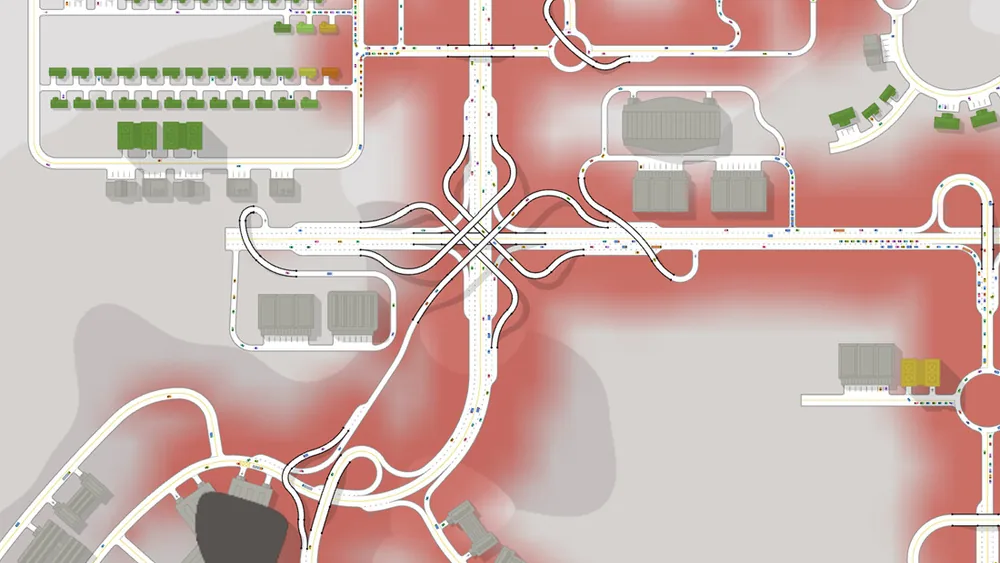
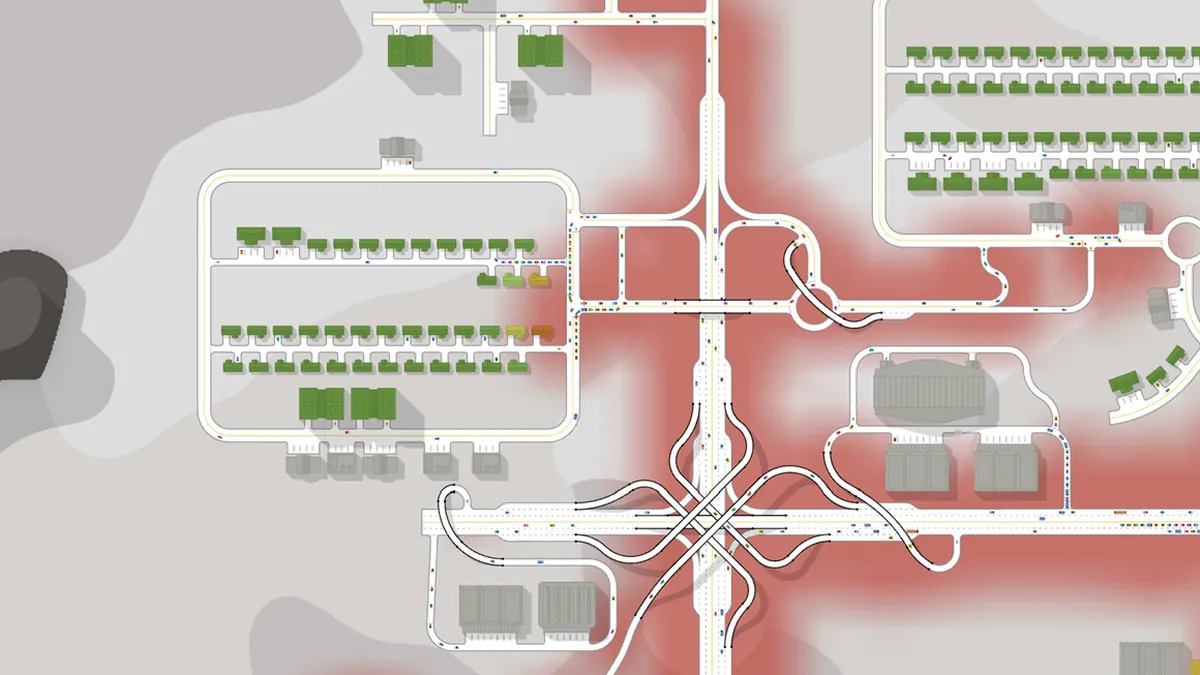
Industrial districts do not follow the residential pattern. A factory takes workers at shift start and raw materials on delivery, and those events cluster around specific times. The result is a second, sharper peak that hits the roads between the industrial zone and the residential area.
Because industrial traffic is heavier per vehicle and often uses a single access road, the shift peak can be more damaging than the commuter peak. The junction at the industrial gate can look fine all day and lock for ten minutes every shift change.
The fix is capacity where the traffic actually is: a dedicated lane for the heavy movement at the industrial junction, and a second access road so the zone is not dependent on a single point.
Designing for the worst hour
Four design choices make a city peak-resistant:
- Two routes to every major destination. Not because the second route is faster, but because a peak that fills one route can spill into the other.
- Turn pockets at junctions that serve a peak direction. A single left-turning car in a through lane during a peak costs more than at any other time.
- A bypass around the centre. Through-traffic should never need to cross the core during a peak, because that is when the core is busiest.
- Industrial access that does not pass residential. A shift-change surge through a neighbourhood is the fastest way to create a permanent jam.
None of these require extra traffic. They require the network to have alternatives before the peak arrives.
Retiming for a peak
If the junction is already signalised, the peak fix is usually a timing change rather than a rebuild. Start with the movement that queues first and give it more of the cycle. Cut the phase that runs empty.
Two rules:
- Do not extend every phase. A longer cycle increases delay for everyone. Extend the phase that is actually busy.
- Keep the protected left short. A left-turn phase that empties early is stealing time from the through movement, and during a peak that matters.
The traffic lights guide→ has starting durations and the phase order to use.
Lengthening the inbound green helps the morning and hurts the evening, when the demand is reversed. If a junction is skewed in both directions at different times, it may need two different layouts - or a roundabout, which does not care which way the peak points.
Peaks and city growth
As a city grows, peaks get sharper before they get longer. A level 10 city has a short morning burst; a level 30 city has a sustained two-hour peak with a second industrial surge. The junction that handled the burst will not handle the surge.
That is why the check should be repeated after every few levels rather than done once. The city expansion guide→ explains the sequence for adding capacity without rebuilding the core, and bottleneck diagnosis→ gives the routine for the junction that finally breaks.
Where the data comes from
- Trafficity on Steam ↗ - store description, price and feature list.
- Trafficity news hub ↗ - patch notes and developer posts.
- Steam global achievement percentages ↗ - the public endpoint behind the completion figures quoted here.
Official source: Trafficity on Steam ↗
FAQ
Why is traffic fine at noon and terrible at eight? Demand is clustered. At peak, the same number of cars arrives in a short window from one direction, which overloads a junction that is balanced for average flow.
Do rush hours exist on Chill difficulty? The simulation still clusters trips around work and deliveries. Chill removes money pressure, not demand.
How do I fix a peak-direction queue? Give the heavy movement more green time or its own lane. Rebuilding the junction is the last step, not the first.
Why does industry jam separately from housing? Shift changes and deliveries create a second surge on the industrial access road, independent of the commuter peak.