
Trafficity Review: A Traffic Puzzle Wearing a City Builder
Trafficity review after launch: what the gridless road tools do well, where the simulation frustrates, how long it lasts and who should skip it.
Trafficity is a city builder for people who do not really want to build a city. The zoning is light, the economy is a nudge rather than a spreadsheet, and almost all of your attention goes to one question: why is this junction failing? If that sounds like a demotion, it is not. The traffic simulation is the game, and it is deep enough to carry a $13.49 purchase for anyone who enjoys fixing systems.
For the short version: buy it if you liked the idea of Mini Motorways but wanted to draw the roads yourself. Skip it if you need a management game with production chains and a campaign. Platform and price details are on the price and platforms page→.
What Trafficity does better than its genre
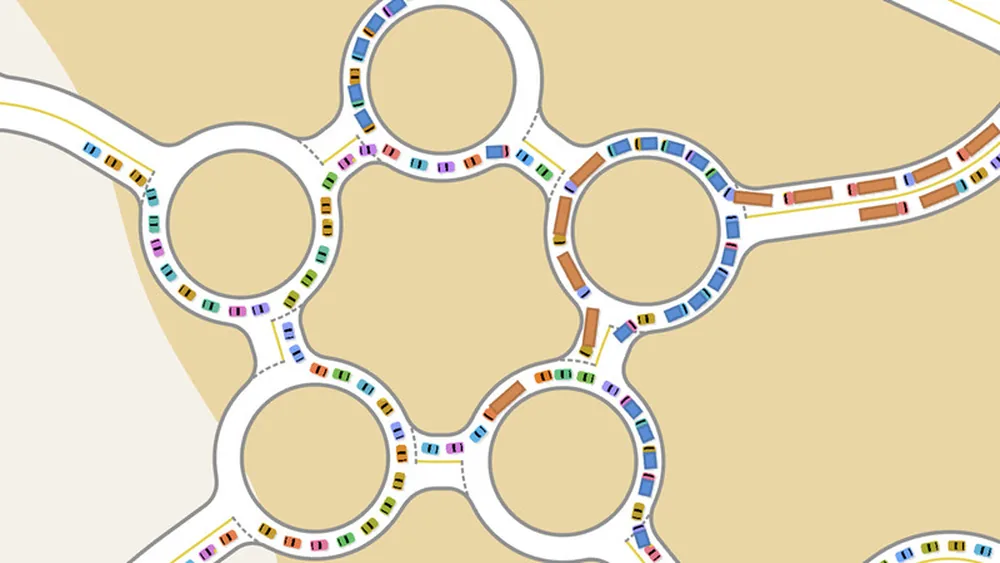
The road tool is the reason to play. There is no fixed grid. You can draw a road grid at any angle in about three clicks, and you can add a single lane to an existing road afterwards - a shoulder that becomes a slip lane, a second lane that only exists on the approach to a junction. Most city builders make you unlock that kind of surgical edit or hide it behind a mod. Here it is the basic vocabulary.
The second strength is the junction editor. Roundabouts, overpasses and traffic lights all behave like real traffic engineering problems rather than decorations. Signals have phases, phase duration steppers, lane connections and protected left turns. You are not choosing a traffic-light asset; you are choosing which movements get a green at the same time. That is a rare level of control in a game this small.
The third is honesty. Cars do not follow a scripted path. They pick the fastest route, use slip lanes, avoid queuing into a junction, and get into the correct lane before a turn. When a junction fails, it fails for a reason you can usually see.
Where it frustrates
The economy is thin, and sometimes it is thin in a way that hides the real problem. A district that will not grow might be short of shops, short of workers, or simply unhappy about road noise. The game tells you a building is unhappy; it is less clear about which of those three is the cause. You will spend time diagnosing a service problem while assuming it is a traffic problem.
The camera and building placement take adjustment. Gridless roads mean gridless mistakes: a road drawn at 43 degrees instead of 45 is legal, but it makes every attached building slightly awkward. There is no undo for a badly drawn block beyond demolishing it.
Difficulty is also uneven. Normal is the right experience. Expert mostly tightens money and requirements, which makes the early game slower without making the traffic puzzles harder. Chill removes money entirely and is best treated as a sandbox for testing layouts, not as a campaign.
There is no story mode and no scenario list beyond the biome and difficulty choice. The loop is: grow a city, hit traffic pressure, fix it, grow further. If you need authored objectives, this will feel repetitive.
How long it lasts
The achievement structure hints at the intended length. There are 27 achievements, built around four biomes and three city levels each - level 10, 25 and 40 - with a separate Expert set. Reaching level 10 on Island is the common path; the global completion percentages drop sharply after that, which suggests most players stop once the first city works.
The realistic first run is a handful of evenings to a working mid-size city, plus whatever time you lose to rebuilding one interchange you are not happy with. Players who chase the level 40 achievements on all four biomes will get far more, because Expert on Alpine and Fjords is a genuinely different traffic problem. The achievement list→ shows the real completion rates.
Performance and stability
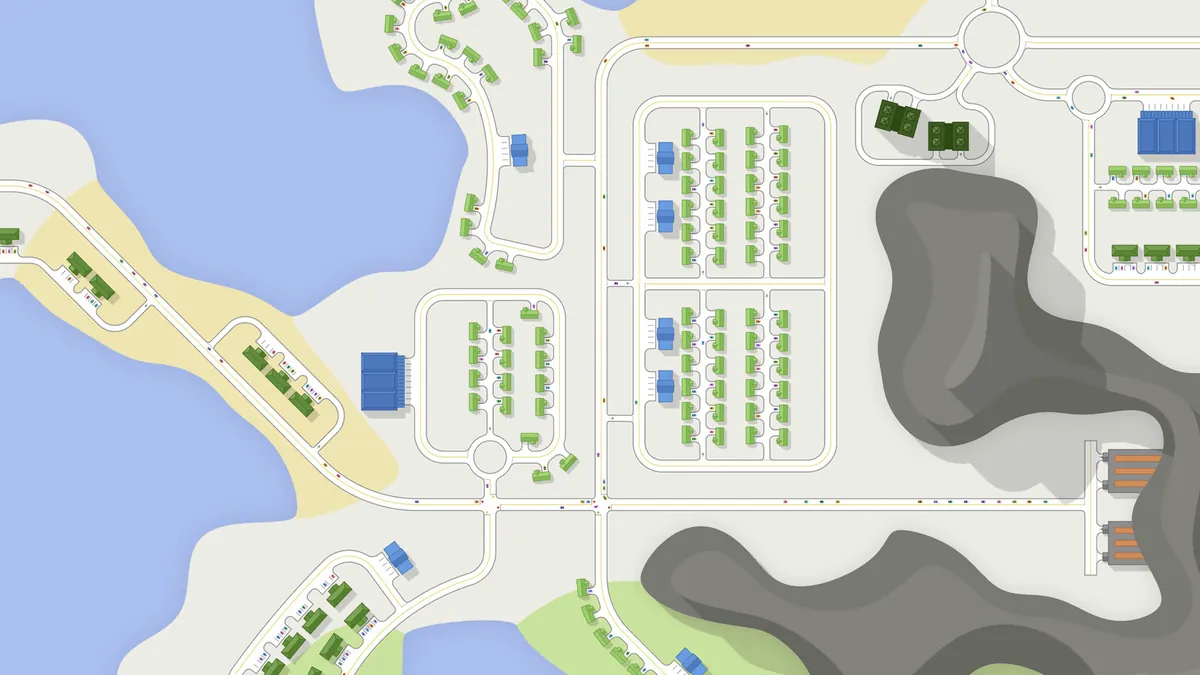
Trafficity is a lightweight game. The art is a flat, warm map style with simple geometry, and the simulation scales by agent count rather than by rendering load. On a modest desktop the frame rate holds while the camera is zoomed out; the cost appears when you zoom into a dense junction during rush hour, where dozens of individual cars are being drawn. Nothing we saw suggested a memory problem on long sessions.
This review is written against the 2026-11-16 release. Junction behaviour and signal options are exactly the kind of thing a patch can change, so treat the specifics as launch-window observations.
Who should buy it
Buy Trafficity if you have ever spent twenty minutes staring at a junction in another city builder, annoyed that you could not just rebuild it properly. Buy it if you like the idea of traffic engineering as a puzzle with no single solution. Buy it if you want a small, honest simulation you can dip into for an hour.
Skip it if you want a management game with supply chains, or if you need a campaign to tell you what to do next. Skip it if you dislike games where the feedback is visual and indirect - the game will not tell you that your left-turn phase is too short, it will just show you a queue.
The comparison that comes up most is with Mini Motorways. The short answer is that Mini Motorways is a draw-a-route puzzle with random road cards, while Trafficity gives you the whole road toolkit and asks you to be the engineer. The full breakdown is in Trafficity vs Mini Motorways→.
Where the data comes from
- Trafficity on Steam ↗ - store description, price and feature list.
- Trafficity news hub ↗ - patch notes and developer posts.
- Steam global achievement percentages ↗ - the public endpoint behind the completion figures quoted here.
Official source: Trafficity on Steam ↗
FAQ
Is Trafficity worth $13.49? Yes, if you enjoy traffic systems. The price is fair for the road tool and junction editor alone; it is high for anyone expecting a full management campaign, because the economy is deliberately simple.
How many hours is Trafficity? A first working city takes a few evenings. The achievement ladder implies dozens of hours if you chase level 40 on every biome, though most players will not.
Is it better than Mini Motorways? They solve different problems. Trafficity gives you direct control of road geometry and signal phasing; Mini Motorways gives you a tighter, more replayable score chase. Neither replaces the other.
Does it run on Steam Deck? The game is light enough that Deck performance is not the concern; control is. The road tool expects precise pointer input, and trackpad drawing is workable but slower. See the platform notes→.