
Trafficity Early Game Layout: Levels 1 to 10
The first ten city levels in Trafficity, block by block: what to build, what to leave empty, and the three junctions that decide whether your save survives.
The first ten levels are not a tutorial. Trafficity gives you the whole road toolkit immediately and lets you build a city that cannot grow. The decisions that matter most happen before level 10, and most of them are about leaving space rather than filling it.
This layout is the skeleton that carries a save into the mid-game. It assumes a Normal-difficulty Island map, but the shape works on any biome if you let the terrain bend the edges. For the absolute basics, start with the beginner guide→.
The first five minutes
You start with a small cluster and a connection to the map edge. Resist the urge to outline the whole future city.
- Draw one arterial from the map edge to the middle of the available land. This is the road that will later become your spine. Keep it straight and wide enough for two lanes.
- Add a second arterial crossing it, roughly perpendicular, so the two form a T or a cross near the centre of the buildable area.
- Place the first residential block between them, not along them. Buildings on an arterial generate turning traffic that will haunt you later. The road hierarchy page→ explains why.
- Leave the four corners of the crossing empty. Those corners are where slip lanes and turn pockets will go when the junction needs them.
That is the entire opening. No grid yet, no second district, no industrial zone.
The first junction
Where the two arterials meet, build a roundabout rather than a bare crossing. Three or four entries, one circulating lane, and nothing else. It will carry the city well past level 10.
The reason is not that roundabouts are always better - it is that this junction will be the busiest one in your early city, and a roundabout degrades predictably. When it starts to queue, you will see which entry is saturated, which is information a signal junction hides inside its phases.
Levels 1 to 5: one district, one shape
Grow a single residential district outward from the crossing. Use the angled grid tool, aligned to the arterial, and keep the block size consistent. Attach shops along the collector roads that lead back to the arterial, not on the arterial itself.
What to build in this phase:
- Housing in a compact grid, one block deep along each collector.
- Shops on the collectors, placed where residents pass them on the way to the arterial.
- One industrial cluster at the map edge, connected to the arterial by its own road.
What not to build:
- A second residential district. The first one is not finished, and a second one doubles the traffic on the same junction.
- A grid across the whole map. You cannot see the future traffic, so you cannot design for it.
Levels 5 to 10: the first real jam
Somewhere in this range the roundabout will start to queue on one entry during the morning peak. That is the intended experience, and it is where the game's core loop begins.
The correct response is not to replace the roundabout. It is to find out which movement is overloading it and give that movement its own path:
- If the queue is on the entry from the residential district, the district may need a second exit to the arterial rather than a bigger roundabout.
- If the queue is on the entry from the industrial side, the industrial access road may need a dedicated lane for the heavy movement.
- If the queue circles the roundabout itself, an exit is blocked - check the road beyond before changing the circle.
The bottleneck diagnosis routine→ is worth running in full the first time. It is slower than guessing and it teaches you what your own city's failure modes look like.
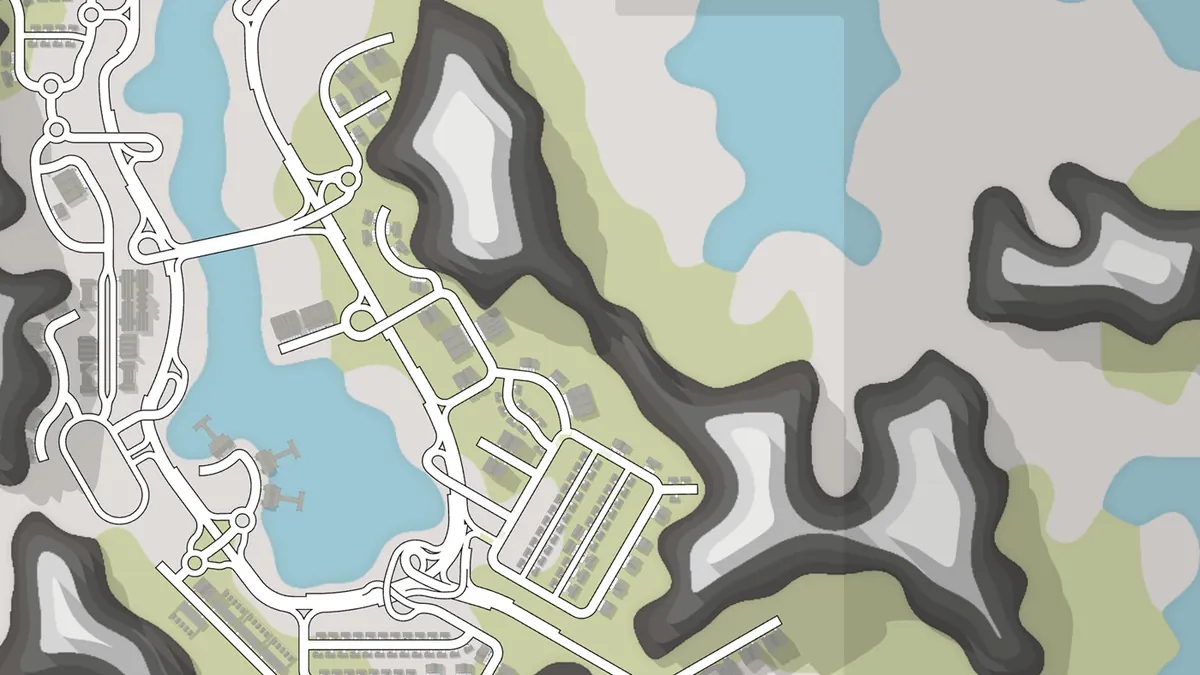
As the district grows, draw a rough circle around it and keep that corridor free of buildings. It is where the ring arterial will go at level 15, and buying the land later means demolishing a neighbourhood.
The three junctions that decide the save
The central roundabout. It carries cross-town traffic and the district's exits. If it is overloaded at level 10, the city will not reach level 20 without a bypass.
The industrial access. Shift changes concentrate traffic here. A single road into the industrial zone is a single point of failure.
The map-edge connection. This is where traffic enters and leaves the map. It is easy to forget because you built it in the first minute, and it becomes a bottleneck surprisingly early.
Inspect all three at the end of level 10. If any of them is red across a full cycle, fix it before adding more buildings. Adding a district on top of a failing junction is how a save becomes a rebuild project.
The fastest way to level up is to place buildings. The fastest way to ruin a save is to place buildings faster than the road network can absorb them. Level progress is a by-product of a working city, not a target.
What level 10 should look like
By the end of the early game you should have: one residential district with a grid, shops on its collectors, one industrial cluster with a dedicated access road, a central roundabout carrying four entries, and an empty ring corridor around the district.
That is a deliberately modest city. It is also a city with room to grow in every direction, which is the whole point. The layout library→ shows what to add next, and the expansion guide→ covers the sequence for the ring and the second district.
Where the data comes from
- Trafficity on Steam ↗ - store description, price and feature list.
- Trafficity news hub ↗ - patch notes and developer posts.
- Steam global achievement percentages ↗ - the public endpoint behind the completion figures quoted here.
Official source: Trafficity on Steam ↗
FAQ
How long does level 10 take? A few hours on Normal, depending on how much time you spend watching traffic. Rushing it with buildings usually produces a jam before level 10.
Should I use a grid or curves early? A grid inside the first district is easier to diagnose. Curve the arterials between districts, not the local streets.
Do I need industry early? Yes. Residents need workplaces, and factories need workers and materials. Place the industrial cluster at the edge with its own access road.
What if the roundabout jams before level 5? Check that the district has more than one exit to the arterial and that the shops are not on the arterial itself. The roundabout is rarely the first cause that early.